
Pierogi recipe: potato and cheese, with a soft sour cream dough
Tender pierogi with a sour cream dough and a potato, cheese and onion filling: rolling, cutting, sealing, boiling, then a golden finish in butter with onions.
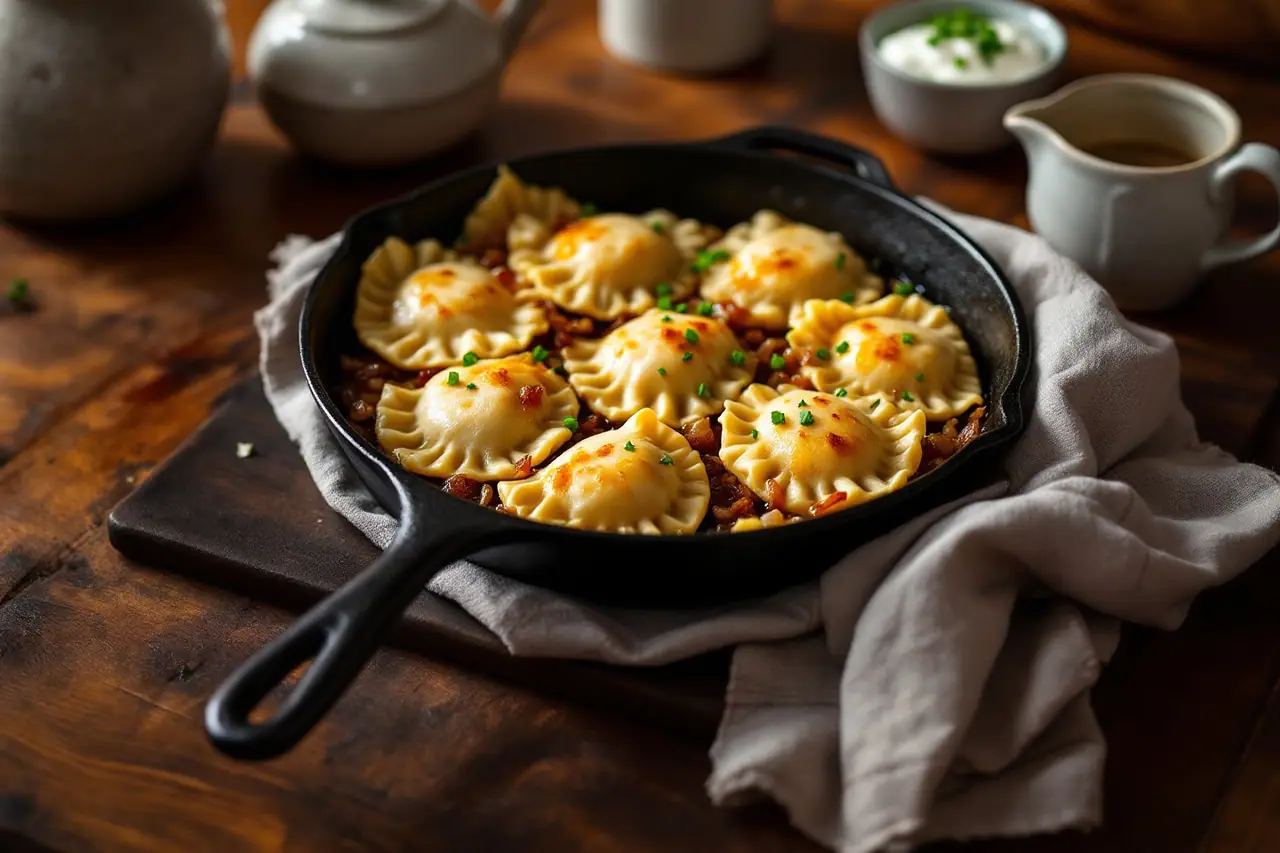
Pierogi are the dumplings I make when the evenings turn cold and I want the kitchen to smell of butter and onions for an afternoon. They are half-moons of soft dough wrapped around a filling, boiled until they float, then often fried in butter until golden at the edges. In Poland, where they are a national treasure, the fillings run from potato and cheese to sauerkraut and mushroom, meat, buckwheat, and in summer, fresh berries. Ukrainian varenyky are close cousins, and both traveled with families to North America, where potato and cheese pierogi became a church-supper and freezer-aisle staple.
This recipe is the potato and cheese version, often called ruskie in Poland, made with farmer's cheese (twaróg) or, in the American way, with sharp cheddar. I make my dough with sour cream, which gives it a tender, slightly rich texture that rolls out easily and does not fight back. It is my version, learned from friends and refined over many batches; Polish grandmothers will each have their own.
The dough
Pierogi dough is simple: flour, egg, sour cream, a little butter or oil, salt and water. The sour cream does two things. Its fat makes the dough tender, and its acidity relaxes the gluten, so the dough is soft and stretchy rather than tough. Many families use only flour, water and egg, which gives a firmer, chewier dough; both are good.
Mix everything into a shaggy dough, then knead for 4 to 5 minutes until smooth and soft. It should feel like an earlobe, as cooks like to say, and barely stick to your hands. If it is sticky, add flour a tablespoon at a time; if it is stiff, a teaspoon of water.
Then rest it. Wrap it and leave it for at least 30 minutes at room temperature. Rested dough rolls out thin without shrinking back, which is the difference between pleasant rolling and a fight. You can make it a day ahead and keep it in the fridge; let it come to room temperature for 30 minutes before rolling.
The filling
The filling is mashed potato with cheese and well-cooked onions. A few things make it good.
Use starchy potatoes, such as russets, for a fluffy, dry mash. Waxy potatoes make a gluey filling. Boil them in salted water until very tender, drain them well and let them steam dry in the pot for a minute or two. Mash or rice them while hot, with no milk: the filling should be firm enough to scoop and hold its shape.
For the cheese, farmer's cheese gives the classic tangy, crumbly Polish flavor. Sharp cheddar gives the creamy, savory Pennsylvania-style filling many Americans grew up with. I often use half of each.
The onions are cooked slowly in butter until soft and golden, about 15 minutes. Half go into the filling, half are kept to serve on top. Season the filling firmly with salt and plenty of black pepper; it gets milder once it is wrapped in dough.
Most importantly, let the filling cool completely before you fill the pierogi. Warm filling makes the dough soft and hard to seal.
Rolling, cutting and sealing
Work with half the dough at a time and keep the rest covered. On a lightly floured counter, roll it thin, about 1/16 to 1/8 inch (2 to 3 mm). Thinner is more delicate; thicker is sturdier for freezing.
Cut rounds with a 3-inch (7.5 cm) cutter or a glass. Gather the scraps, knead them briefly, cover them, and reroll after a 10 minute rest.
Put a heaping teaspoon of filling in the center of each round, about 15 g. Fold the dough over into a half-moon and pinch the edges firmly together from one end to the other, pressing out air as you go. If the dough is dry or floury at the edges, touch it with a wet fingertip first. For a decorative edge, crimp it with a fork or fold the edge over itself in small pleats, which also makes a stronger seal.
Set the finished pierogi on a floured tray, not touching, and cover them with a towel while you make the rest.
A worked number: this dough makes about 40 rounds of 3 inches (7.5 cm), and the filling below fills about 40 at 15 g each. That is dinner for four to five, or two dinners and a bag in the freezer.
Boiling and frying
Bring a large pot of salted water to a gentle boil. Add the pierogi in batches of 10 or 12 so they have room. Stir gently once so none stick to the bottom. They will sink, then float to the top. Once they float, cook them for 2 to 3 minutes more, then lift them out with a slotted spoon.
You can eat them just like that, tossed in melted butter. For the version I love most, fry the boiled pierogi in a skillet with butter over medium heat for 2 to 3 minutes a side, until golden and a little crisp, then pile the reserved onions on top. Sour cream on the side, chives if you have them.
The recipe
Potato and cheese pierogi
- Makes
- About 40 pierogi, serves 4 to 5
- Prep
- 1 hr 30 min
- Cook
- 30 min
- Total
- 2 hr
Ingredients
Dough
- 3 cups375 g all-purpose flour, plus more for rolling
- 1 tsp fine salt
- 1 large egg
- 1/2 cup120 g sour cream
- 2 tbsp30 g butter, melted
- 1/2 cup120 ml warm water, plus a little more if needed
Filling
- 1 1/2 lb680 g russet potatoes, peeled and cut in chunks
- 4 tbsp60 g butter
- 2 medium yellow onions, finely chopped
- 1 cup225 g farmer's cheese, or 1 1/2 cups (150 g) grated sharp cheddar, or half of each
- 1 tsp fine salt, or to taste
- 1/2 tsp black pepper
To serve
- 3 tbsp45 g butter, for frying
- 1/2 cup120 g sour cream
- 2 tbsp chopped chives or dill
Method
- Mix the flour and salt in a bowl. Add the egg, sour cream, melted butter and warm water and stir into a shaggy dough.
- Knead for 4 to 5 minutes until smooth and soft, adding a little flour or water as needed. Wrap and rest for at least 30 minutes.
- Boil the potatoes in salted water until very tender, about 15 minutes. Drain, steam dry for a minute, then mash without milk.
- Meanwhile, cook the onions in the butter over medium-low heat for about 15 minutes, until soft and golden.
- Mix the mashed potato with the cheese, half the onions, salt and pepper. Keep the rest of the onions for serving. Cool the filling completely.
- Roll half the dough out to about 1/16 to 1/8 inch (2 to 3 mm) and cut 3 inch (7.5 cm) rounds. Keep the other half covered.
- Put about 15 g of filling on each round, fold into a half-moon and pinch the edges firmly closed. Set on a floured tray.
- Boil in batches in a large pot of salted water until they float, then 2 to 3 minutes more. Lift out with a slotted spoon.
- Fry the boiled pierogi in butter over medium heat for 2 to 3 minutes a side until golden. Serve with the reserved onions, sour cream and chives.
Cook's notes
- Freeze uncooked pierogi on a floured tray until hard, then bag them. Boil from frozen, adding 2 to 3 minutes.
- Leftover boiled pierogi reheat best fried in butter.
Making an afternoon of it
Pierogi are a project, and they are best made with company. In my kitchen the jobs split naturally: one person rolls and cuts, one fills, and one pinches and sets the finished pierogi on the tray. With three people, a double batch of 80 takes a little over an hour, and everyone goes home with a bag for the freezer. Put the onions on before the dough is rolled, so the kitchen smells right while you work.
Freezing pierogi
Pierogi freeze beautifully, which is one of the best reasons to make a big batch. Freeze them uncooked, on a floured, parchment-lined tray, without touching, until they are hard, about 2 hours. Then bag them. They keep well for about 3 months.
Cook them straight from frozen. Drop them into boiling salted water, stir gently, and cook until they float and then 3 to 4 minutes more. Do not thaw them first, because thawed raw pierogi turn sticky and tear.
You can also boil them, cool them, toss them in a little melted butter and freeze them cooked. Those reheat quickly in a buttered skillet.
Other fillings to try
- Sauerkraut and mushroom: drained, chopped sauerkraut cooked with onions and dried porcini, a Christmas Eve favorite in many Polish homes.
- Farmer's cheese and potato with plenty of dill.
- Sweet cheese: farmer's cheese with egg yolk, sugar and a little vanilla, served with sour cream and sugar.
- Blueberries or cherries in summer, sealed very well, boiled and served with sweetened sour cream.
- Leftover meat: finely chopped cooked beef or pork with onions, a good use for a Sunday roast.
Troubleshooting
- Pierogi opening in the water: the edges were not sealed well, or floury. Wet the edge before pressing and pinch firmly. Do not overfill.
- Tough dough: too much flour, or not enough rest. Keep it soft and let it rest longer.
- Dough shrinking as you roll: it needs more rest. Cover it and wait 10 minutes.
- Gummy filling: waxy potatoes or added milk. Use russets and keep the mash dry.
How pierogi fit with the other dumplings
If you have folded gyoza, pierogi will feel easy: there are no pleats to learn, only a firm pinch. The habits are the same as in the pork and cabbage gyoza piece: a cold, firm filling, edges kept moist, and a floured tray for the finished dumplings. For more to fold, boil and fry, browse the dumplings kitchen, and for another way to stock the freezer, see freezing meatballs, raw or cooked.
Questions people ask
Do I have to boil pierogi before frying?
Yes, for fresh or frozen raw pierogi. Boiling cooks the dough through; frying afterwards adds color and crunch.
Can I make the dough without sour cream?
Yes. Use 3/4 cup (180 ml) warm water in total with the egg and a tablespoon of oil. The dough will be a little firmer.
What cheese is best for pierogi?
Farmer's cheese for the classic Polish flavor, sharp cheddar for the American style, or both together.

Odile Moreau
Odile cooked her way through her Alsatian grandmother's notebooks and learned to pleat dumplings in a shared kitchen in Montreal. She writes about gyoza, pierogi, soup dumplings, Swedish meatballs and the gravies and dipping sauces that go with them.
Cook next
Pork and cabbage gyoza, pleated and pan-fried
Juicy pork and napa cabbage gyoza with a crisp golden base: the filling, the pleat step by step, the fry-steam-fry method, a lacy wing, and freezing a batch.
Cook this one →
Matzo ball soup: light floaters or dense sinkers
A clear chicken soup with carrots and dill, and matzo balls made the way you like them, light and fluffy or firm and dense, with the reasons each one turns out that way.
Cook this one →