
Pork and cabbage gyoza, pleated and pan-fried
Juicy pork and napa cabbage gyoza with a crisp golden base: the filling, the pleat step by step, the fry-steam-fry method, a lacy wing, and freezing a batch.
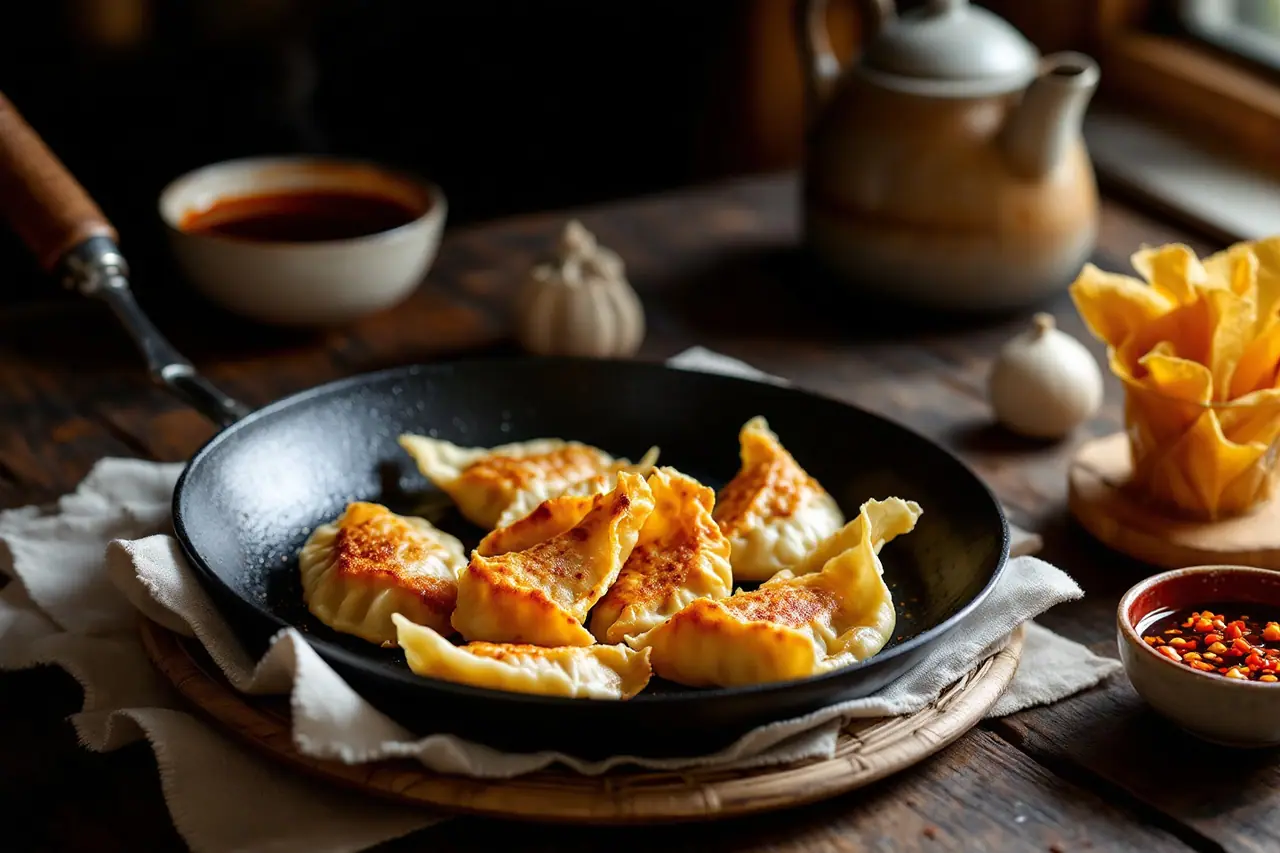
There is a particular sound I wait for when making gyoza. The dumplings sizzle in oil, then you pour in a splash of water and slam the lid down, and the pan hisses and spits for a few minutes. When the hissing fades back into a gentle frying crackle, the water has gone, the filling is cooked, and the bottoms are turning golden again. That change in sound is the whole method in miniature.
Gyoza are the Japanese pan-fried dumplings that came from Chinese jiaozi, usually filled with pork, cabbage, garlic and ginger, and cooked so that one side is crisp and brown while the rest stays soft and steamed. I learned to fold them in a shared kitchen in Montreal, standing at a long table with three other people and a mountain of wrappers, and the pleating went from hopeless to automatic in about one afternoon. It will for you too. Here is the filling, the fold described slowly, the cooking method, and how to freeze a big batch.
The filling
A good gyoza filling is juicy, well seasoned and bound together so it holds as one piece when you bite in. It has three parts.
Start with the pork: ground pork with some fat, not lean. The fat keeps the filling moist and carries the flavor of the aromatics. If you can only find lean pork, add a tablespoon of neutral oil.
For the cabbage, napa is the usual choice; it is tender and sweet. Chop it finely, then salt it and let it sit for 15 minutes. The salt pulls out water. Squeeze the cabbage hard in a clean towel or with your hands until it is much smaller and fairly dry. This is the step that keeps your filling from turning wet and your wrappers from going soggy. Do not skip it.
The aromatics and seasoning are garlic, fresh ginger, scallions or garlic chives (nira, which give a lovely mild garlic flavor), soy sauce, sesame oil, a little sugar, white pepper, and a splash of sake or water if you have it.
The mixing matters. Put the pork and seasonings in a bowl and stir in one direction with chopsticks or a spoon for a minute or two, until the mix turns sticky and starts to cling to itself. Then fold in the squeezed cabbage and scallions. That sticky stage binds the filling so it stays juicy rather than crumbling.
Wrappers
Store-bought round gyoza wrappers are what most home cooks use, and they are very good. Look for thin, round wrappers about 3 1/2 inches (9 cm) across, often labeled gyoza or potsticker wrappers, in the refrigerated or frozen section. Thaw frozen ones in the fridge, and keep the stack covered with a damp towel while you work, because the edges dry out and crack in minutes.
Homemade wrappers are wonderful and chewier, made from flour and hot water, but they are a project of their own. For a first batch, buy them.
The pleat, step by step
The classic gyoza fold has pleats along one side and a smooth curve along the other, which makes the dumpling sit upright in the pan with a flat bottom. Here is how I do it.
- Hold a wrapper flat in the palm of your non-dominant hand.
- Put about 1 heaping teaspoon of filling (around 12 g) in the center. Less than you think. Overfilled gyoza split.
- Dip a fingertip in water and wet the edge of the top half of the wrapper, all around the curve.
- Fold the wrapper in half over the filling, like a taco, but do not press it closed yet. Pinch it shut only at the very center of the top.
- Now work on one side. With the thumb and finger of your dominant hand, make a small fold in the front layer of the wrapper only, pushing it toward the center pinch, and press it against the flat back layer.
- Repeat, making two or three more small pleats toward the center. Then go to the other side and pleat toward the center from that end, two or three more times. That is five to seven pleats in total.
- Press along the whole top edge to seal, squeezing out any air.
- Set the dumpling down on its smooth, unpleated side and press gently so it sits flat.
The first ten will look uneven. That is fine; they cook and taste the same. By the twentieth, your fingers will have learned it. Keep the finished gyoza on a tray dusted with flour or cornstarch and lined with parchment, not touching, so they do not stick.
A pack of 50 wrappers and the filling below make about 48 gyoza, enough for four people with rice and a side, or a big tray to freeze.
Fry, steam, fry
This is the classic method, and it is easy once you have done it once.
Use a nonstick or well-seasoned skillet with a tight lid. Heat a tablespoon of neutral oil over medium-high heat. Set the gyoza in the pan flat side down, in neat rows or a circle, close together but not overlapping. Fry for about 2 minutes, until the bottoms are golden.
Pour in about 1/3 cup (80 ml) of water for a 10-inch (25 cm) pan, carefully, because it will spit. Immediately cover the pan. Turn the heat to medium and let them steam for 4 to 5 minutes, until the wrappers turn slightly translucent and the filling is cooked. Pork filling should reach 160°F (71°C) in the center; at this size, 5 minutes of steaming gets there easily.
Take the lid off. Let the remaining water cook away, then fry for another minute or two until the bottoms are crisp and deep golden again. Drizzle a few drops of sesame oil around the edge for flavor. Loosen them with a spatula.
The lacy wing
For the crisp, lacy skirt that joins the dumplings together (hane, or "wings"), replace the plain steaming water with a thin slurry: 1 teaspoon of cornstarch or flour stirred into the 1/3 cup (80 ml) of water. Pour it in exactly as above. As the water evaporates, the starch stays behind and fries into a thin, golden lattice. When it is crisp and the edges lift from the pan, put a plate over the skillet and flip the whole thing over in one go, so the gyoza come out crisp side up, joined by the wing. It is very satisfying, and it hides uneven pleats beautifully.
Dipping sauce
The usual sauce is soy sauce and rice vinegar in about equal parts, with chili oil (rayu) to taste. Some people add a little sesame oil or a pinch of sugar. Mix it in a small dish for each person.
The recipe
Pan-fried pork and cabbage gyoza
- Makes
- About 48 gyoza, serves 4
- Prep
- 1 hr
- Cook
- 30 min
- Total
- 1 hr 30 min
Ingredients
Filling
- 4 cups300 g napa cabbage, finely chopped
- 1 tsp fine salt, for the cabbage
- 1 lb450 g ground pork, not lean
- 3 cloves garlic, finely grated
- 1 tbsp fresh ginger, finely grated
- 1 tbsp15 ml soy sauce
- 1 tbsp15 ml sake or water
- 2 tsp10 ml toasted sesame oil
- 1 tsp sugar
- 1/4 tsp ground white pepper
- 1/2 cup30 g garlic chives or scallions, finely chopped
To fold and cook
- 50 round gyoza wrappers, about 3 1/2 inches (9 cm), thawed if frozen
- 1 small bowl water, for sealing
- 2 tbsp30 ml neutral oil, per batch
- 1/3 cup80 ml water per batch, plus 1 tsp cornstarch for a lacy wing (optional)
- 1 tsp5 ml toasted sesame oil, to finish
Dipping sauce
- 3 tbsp45 ml soy sauce
- 3 tbsp45 ml rice vinegar
- to taste chili oil
Method
- Toss the chopped cabbage with the salt and leave it for 15 minutes, then squeeze it hard in a clean towel until fairly dry.
- In a bowl, stir the pork with the garlic, ginger, soy sauce, sake, sesame oil, sugar and white pepper in one direction for 1 to 2 minutes, until sticky.
- Fold in the squeezed cabbage and the chives or scallions. Chill the filling while you set up a tray dusted with flour or cornstarch.
- Put about 1 heaping teaspoon (12 g) of filling in the center of a wrapper, wet the top half of the edge, fold it over and pinch the center closed.
- Make 2 or 3 small pleats in the front layer on each side, pressing each one toward the center against the back layer, then press the whole edge to seal. Set it flat side down on the tray. Repeat.
- Heat 1 to 2 tablespoons of oil in a nonstick skillet with a lid over medium-high heat. Add gyoza flat side down, close together, and fry for 2 minutes until golden underneath.
- Pour in 1/3 cup (80 ml) water (or the cornstarch slurry for a wing), cover at once, lower the heat to medium and steam for 4 to 5 minutes.
- Uncover and cook until the water has evaporated and the bottoms are crisp again, 1 to 2 minutes. Drizzle a little sesame oil around the edge.
- Loosen with a spatula, or flip onto a plate crisp side up. Serve with the dipping sauce, and cook the next batch.
Cook's notes
- Freeze uncooked gyoza on the floured tray until hard, then bag them. Cook from frozen with 2 minutes more steaming.
- Keep the wrappers under a damp towel while you fold so the edges do not dry and crack.
Freezing a batch
Gyoza are one of the best things to keep in the freezer. Fold a full batch, set the tray in the freezer uncovered for 1 to 2 hours until the dumplings are hard, then tip them into a freezer bag. They will not stick together. They keep well for about 3 months.
Cook them straight from frozen, no thawing: fry the bottoms as usual, add the water, cover, and steam for 6 to 7 minutes instead of 4 to 5, then crisp. Thawing makes the wrappers soggy and sticky, so resist it.
Variations
- Shrimp and pork: replace a third of the pork with chopped raw shrimp.
- Chicken: use ground thigh meat, which stays juicier than breast, and cook to 165°F (74°C).
- Vegetable: finely chopped shiitake, carrot, cabbage and crumbled firm tofu, squeezed dry, with the same seasoning.
- Boiled or steamed: the same gyoza can be boiled for about 4 minutes or steamed in a basket lined with cabbage leaves for about 8 minutes, for a soft dumpling with no crisp side.
Common problems
- Soggy bottoms: the cabbage was not squeezed well, or the pan was not hot enough before the gyoza went in.
- Torn wrappers: too much filling, or dry edges. Use less filling and keep the wrappers covered.
- Stuck to the pan: use a nonstick pan, or make sure a seasoned pan and its oil are properly hot.
- Raw filling: the lid was not tight, or the water evaporated too soon. Add another splash and cover again.
Books that taught me more folds
Once the basic pleat feels easy, there is a whole world of folds to try, and a good book helps more than any video because you can keep it open on the counter. Andrea Nguyen's "Asian Dumplings" is the one I return to most. It covers wrappers, fillings and folds from Japanese gyoza and Chinese jiaozi to Korean mandu, momos and samosas, with clear step photographs for the pleats. It made me braver with homemade dough.
If you are new to dumplings, the habits here carry over from other kitchens too. The gentle, one-direction mixing that makes a gyoza filling sticky is close to how you would handle a meatball mix, and the patience with dough is the same patience you need for matzo balls. More to fold and steam is in the dumplings kitchen.

Odile Moreau
Odile cooked her way through her Alsatian grandmother's notebooks and learned to pleat dumplings in a shared kitchen in Montreal. She writes about gyoza, pierogi, soup dumplings, Swedish meatballs and the gravies and dipping sauces that go with them.
Cook next
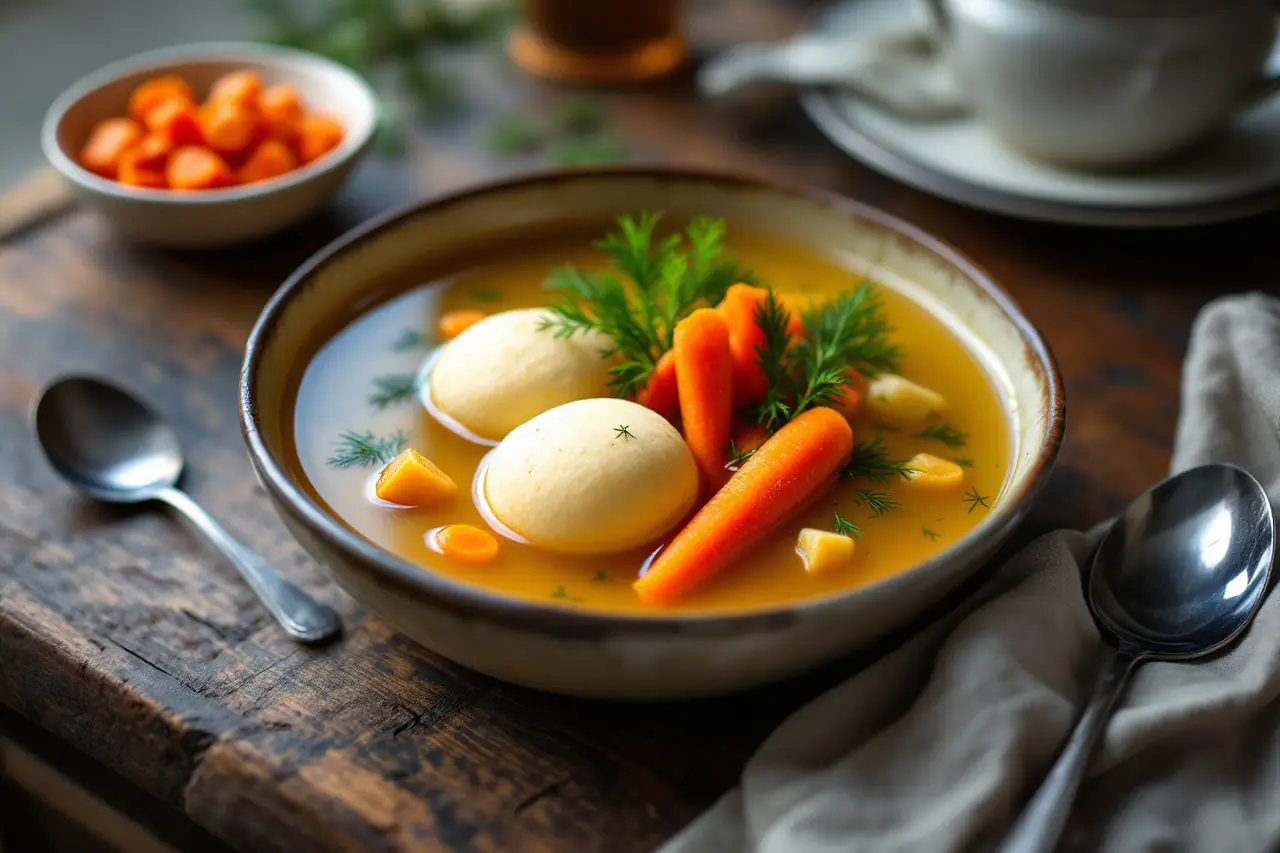
Matzo ball soup: light floaters or dense sinkers
A clear chicken soup with carrots and dill, and matzo balls made the way you like them, light and fluffy or firm and dense, with the reasons each one turns out that way.
Cook this one →