
Matzo ball soup: light floaters or dense sinkers
A clear chicken soup with carrots and dill, and matzo balls made the way you like them, light and fluffy or firm and dense, with the reasons each one turns out that way.
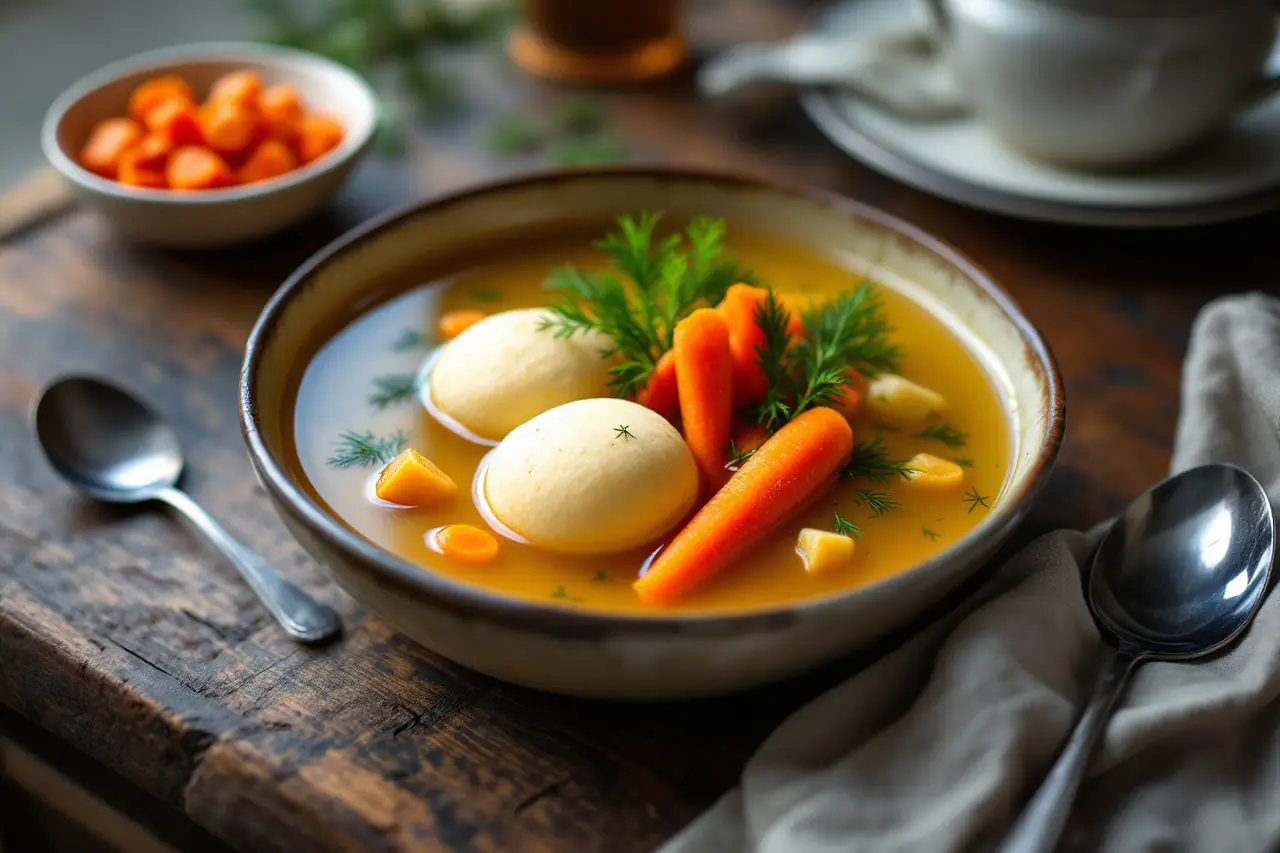
Matzo ball soup is a Jewish home classic, on the table for Passover and for a cold evening any other week of the year. It is two things in one bowl: a clear, golden chicken soup, and soft dumplings made from matzo meal, eggs and fat. Ask three families about the dumplings and you will hear about floaters and sinkers. Floaters are light, airy and bob at the surface. Sinkers are dense, firm and settle at the bottom of the bowl. Both have loyal fans, and neither is a mistake. They come from small, predictable differences in the mix and in how you handle it.
I am the person in my house who likes to know why food behaves the way it does, so this piece is half recipe and half explanation. Once you know which levers move a matzo ball from sinker to floater, you can make exactly the kind your table argues for.
What a matzo ball is made of
The basic mix is short. Matzo meal (finely ground matzo), eggs, fat, a liquid, and salt. That is all.
The matzo meal is the structure. More meal per egg gives a firmer, denser ball. Less gives a softer, lighter one.
The eggs bind it and, when beaten, carry a little air.
The fat keeps the texture tender. Schmaltz (rendered chicken fat) is the traditional choice and gives the best flavor. Neutral oil works perfectly well and is what many families use.
The liquid loosens the mix. Water, chicken stock or seltzer. Seltzer is the old trick for floaters: its bubbles add lift. Stock adds flavor.
Some families add a pinch of baking powder for extra lift, chopped dill or parsley, a little grated onion, or a pinch of nutmeg or ginger. None of these is required.
Floaters and sinkers: the levers
Here is what moves the texture, roughly in order of how much difference each makes.
| Change | Toward lighter (floaters) | Toward denser (sinkers) |
|---|---|---|
| Matzo meal per egg | Less, about 1/4 cup (30 g) per egg | More, about 1/3 cup (40 g) or more per egg |
| Liquid | Seltzer | Water or none |
| Mixing | Stir just until combined | Stir longer and firmly |
| Shaping | Roll gently, barely pressed | Pack firmly |
| Cooking | Covered, at a steady simmer, the full time | Shorter cooking, or uncovered |
| Baking powder | A pinch helps | Leave it out |
The resting time matters for both. The matzo meal needs at least 30 minutes in the fridge to absorb the liquid. Skip it and the balls are gritty and fall apart; rest it properly and the mix firms into something you can roll.
The recipe below sits in the middle, leaning light: tender, holds its shape, and floats for most of the cooking. To go lighter, use the full amount of seltzer, the baking powder, and the gentlest hands you have. To go denser, add 2 or 3 extra tablespoons of matzo meal and use water instead of seltzer.
Cook them in water, not in the soup
This is the habit that surprises people. Matzo balls absorb a lot of liquid as they cook and swell to about twice their size, and they shed some of their meal into the pot. Cooked in your soup, they cloud it and drink up the broth you worked for. Cooked in a big pot of well-salted water, they puff freely, and your soup stays clear.
Use the widest pot you have, because the balls need room to double. Bring the water to a boil, salt it as you would pasta water, drop the balls in, cover tightly and turn the heat down to a steady simmer. Do not lift the lid for the first 20 minutes: the trapped steam helps them cook through and puff. Total time is 30 to 40 minutes for balls rolled at about 1 1/4 inches (3 cm). Cut one open to check: it should be evenly cooked to the center, with no darker, dense core.
Lift them out with a slotted spoon and drop them into the hot soup just before serving, or store them separately.
The soup
A good chicken soup for matzo balls is simple and clear. Chicken pieces with bones and skin (thighs, drumsticks, wings, or a cut-up whole bird) give the most flavor. Cover them with cold water, bring it up slowly, and skim the foam that rises in the first 15 minutes. Add onion, carrot, celery, parsnip if you like it, a few peppercorns and a bay leaf. Then keep it at a gentle simmer, never a rolling boil, which emulsifies the fat and clouds the broth.
After about 1 1/2 hours the chicken is tender and the broth tastes of it. Strain it, skim off some of the fat (save it, it is schmaltz in the making), season it properly with salt, and add fresh sliced carrots to cook until tender. Pick the meat off the bones and add some back to the bowls if you like. Finish with plenty of chopped dill.
If you are short on time, a good store-bought chicken stock simmered for 20 minutes with fresh carrot, celery, onion and dill is a fair weeknight shortcut.
A worked plan for a holiday table
Matzo ball soup is ideal for working ahead, which matters when the oven and the stove are busy with everything else. Here is how I spread it over two days for twelve people.
- Day before, morning: make a double batch of soup, strain, cool and refrigerate. The fat sets on top and lifts off in one piece.
- Day before, afternoon: mix a double batch of matzo balls (16 eggs' worth would be too much; two batches of the recipe below give about 32 balls, enough for two each plus seconds), chill for an hour, roll, and cook in two pots of salted water.
- Cool the cooked balls on a tray, then refrigerate them in a container with a ladle of soup so they do not dry out.
- On the day: bring the soup to a simmer with fresh carrots, add the matzo balls 15 minutes before serving to heat through, and finish with dill.
The recipe
Chicken soup with matzo balls
- Makes
- About 16 matzo balls and 3 quarts of soup, serves 8
- Prep
- 35 min
- Cook
- 2 hr
- Total
- 2 hr 35 min
Ingredients
Soup
- 4 lb1.8 kg bone-in chicken pieces (thighs, drumsticks, wings)
- 4 quarts3.8 liters cold water
- 2 yellow onions, halved
- 4 carrots, 2 in chunks for the broth and 2 sliced for serving
- 3 ribs celery, in chunks
- 1 parsnip, in chunks (optional)
- 1 tsp black peppercorns
- 1 bay leaf
- 1 tbsp kosher salt, plus more to taste
- 1 small bunch fresh dill, chopped
Matzo balls
- 4 large eggs
- 1/4 cup60 ml schmaltz (melted) or neutral oil
- 1/4 cup60 ml seltzer or chicken stock
- 1 cup120 g matzo meal
- 1 tsp1 tsp (about 5 g) fine salt
- 1/4 tsp baking powder (optional, for lighter balls)
- 1 tbsp chopped dill or parsley (optional)
Method
- Put the chicken in a large pot with the cold water and bring it slowly to a simmer over medium heat, skimming off the foam as it rises for the first 15 minutes.
- Add the onions, carrot chunks, celery, parsnip, peppercorns, bay leaf and salt. Keep at a gentle simmer, partly covered, for 1 1/2 hours.
- While the soup simmers, whisk the eggs, schmaltz or oil and seltzer in a bowl. Stir in the matzo meal, salt, baking powder and herbs just until combined. Cover and refrigerate for at least 30 minutes, up to 4 hours.
- Bring a wide pot of water to a boil and salt it well, about 1 tablespoon of kosher salt per 2 quarts (2 liters).
- With wet hands, roll the chilled mix gently into balls about 1 1/4 inches (3 cm) across. They will double in size.
- Lower the balls into the boiling water, cover tightly, reduce to a steady simmer and cook for 30 to 40 minutes without lifting the lid for the first 20. Cut one open to check that it is cooked to the center.
- Strain the soup, discard the vegetables and set the chicken aside. Skim some of the fat from the broth and season it well with salt.
- Add the sliced carrots to the broth and simmer for 10 minutes until tender. Shred some of the chicken back into the pot if you like.
- Lift the matzo balls into the hot soup with a slotted spoon, simmer for 5 minutes, and serve with plenty of chopped dill.
Cook's notes
- For denser balls, add 2 to 3 tablespoons more matzo meal and use water instead of seltzer.
- Store cooked matzo balls separately from the soup, in a little broth, for up to 3 days in the fridge.
Making a little schmaltz
You do not have to buy schmaltz. The fat you skim from the cooled soup is most of the way there. Lift it off the cold broth, put it in a small pan over low heat and let it bubble gently for 10 to 15 minutes, until the water has cooked off and the fat is clear and golden. Strain it into a jar. A batch of soup usually gives enough for one or two rounds of matzo balls, and it keeps for weeks in the fridge.
For a richer version, render chicken skin and a sliced onion together over low heat until the skin is crisp and the onion is deep brown. The fat is schmaltz, and the crisp bits (gribenes) are a cook's snack that rarely makes it to the table.
When the soup tastes flat
A pale, thin-tasting soup almost always needs one of three things. More salt, added a little at a time and tasted after each addition, because chicken soup goes from flat to lovely with surprisingly little. More time, if the chicken was mostly breast meat, which gives less flavor than thighs and wings. Or a squeeze of lemon just before serving, which brightens it without making it taste sour.
Storing and freezing
Soup and matzo balls keep for 3 to 4 days in the fridge, stored separately. Matzo balls left sitting in soup keep absorbing it and turn soft, so I only combine them to reheat.
Both freeze. Freeze the broth in containers with an inch of headroom. Freeze cooked matzo balls on a tray, then bag them; reheat them straight from frozen in simmering soup for about 15 minutes, until hot through. Leftover soup should be reheated to a full simmer, 165°F (74°C), before serving.
Small variations
- Add a tablespoon of grated onion or a pinch of ground ginger to the matzo ball mix for a little more flavor.
- Use stock instead of seltzer for richer, slightly denser balls.
- For a smaller batch, halve the matzo ball recipe: 2 eggs, 2 tablespoons fat, 2 tablespoons liquid, 1/2 cup meal.
- Swap half the chicken for a turkey wing or neck for a deeper broth.
How this fits with the other dumplings
A matzo ball is a cousin of every other boiled dumpling: a starch bound with egg and fat, shaped by hand, cooked gently in plenty of liquid. The same rules about even sizing and wet hands from the classic meatball method apply here, and if you enjoy the rolling, the dumplings kitchen has more to fold and simmer.
Questions people ask
Why did my matzo balls fall apart?
The mix probably did not rest long enough, or the water was boiling too hard. Chill the mix for at least 30 minutes and keep the pot at a steady simmer with the lid on.
Can I cook matzo balls in the soup?
You can, but they will cloud the broth and absorb a lot of it. Cooking them in salted water and adding them at the end keeps the soup clear.
How do I know they are done?
Cut one in half. A cooked matzo ball is the same color and texture all the way through. A darker, dense center means it needs more time.
Can I make them without schmaltz?
Yes. Neutral oil works well and is what many families use. Schmaltz adds a deeper chicken flavor.

Sam Whitlock
Sam is the freezer planner in his house and the one who actually reads the air fryer manual. He writes about batch cooking, reheating, timings, safe temperatures and turning one big tray of meatballs into a week of dinners.
Cook next
Pork and cabbage gyoza, pleated and pan-fried
Juicy pork and napa cabbage gyoza with a crisp golden base: the filling, the pleat step by step, the fry-steam-fry method, a lacy wing, and freezing a batch.
Cook this one →