
Meatballs & PolpetteWeeknight Tables
Turkey meatballs that stay juicy, for busy weeknights
Why ground turkey turns dry and the fixes that stop it: dark meat, a bread paste, grated onion, a quick roast and a short simmer. Mild for kids, spicy for adults.
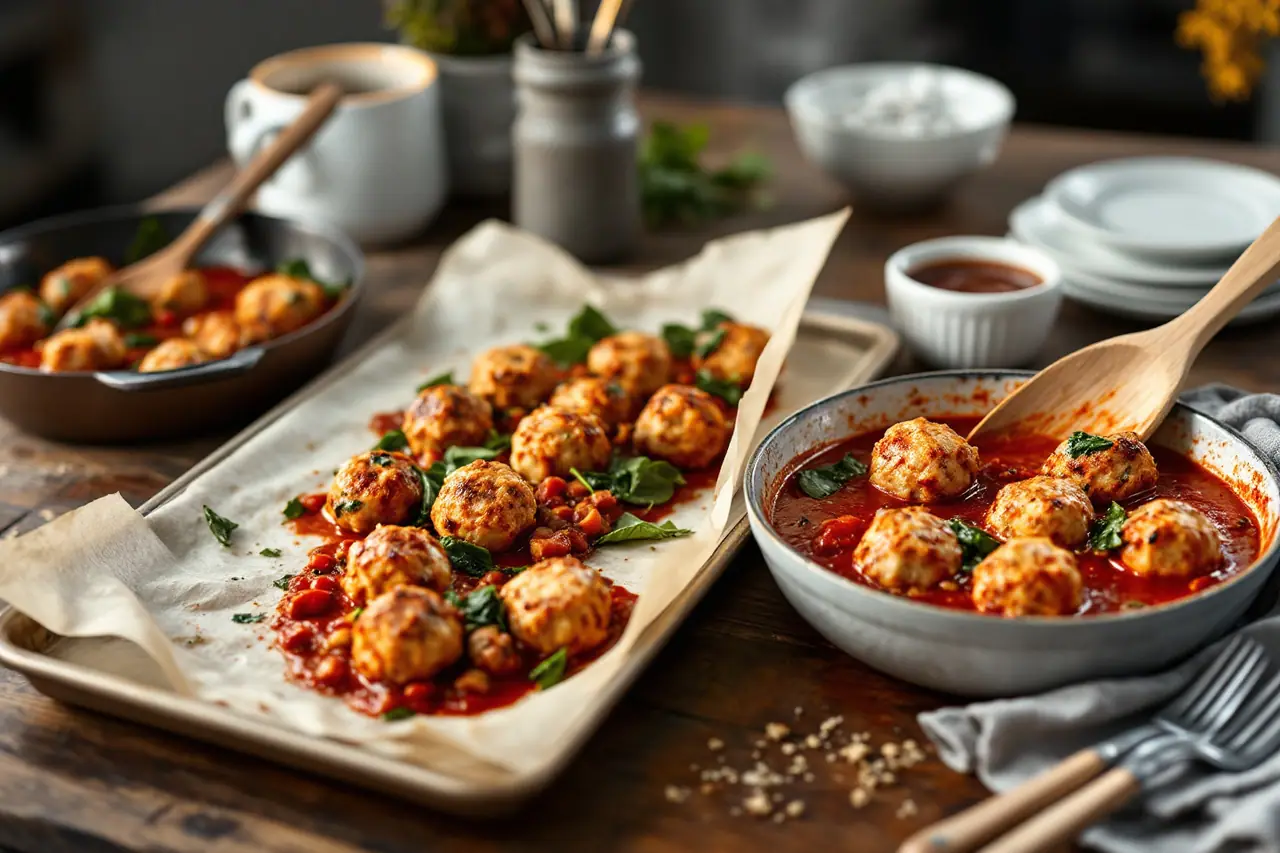
In my house, turkey meatballs are a Tuesday food. Ground turkey is easy to find, it takes seasoning well, and my three children will eat it without negotiation, which is more than I can say for most things that come out of my kitchen. The trouble is that turkey meatballs have a reputation, and they earned it. Made like beef meatballs, they come out pale, tight and dry, and the sauce does all the work of making them edible.
They do not have to be like that. Turkey needs a few things that fattier meat brings along for free, and once you add them, a turkey meatball is tender, juicy and genuinely good. Here is what goes wrong, what fixes it, and the version I make most weeks, with a mild one for the children and a spicier one for the grown-ups.
Why turkey meatballs go dry
Most ground turkey in American supermarkets is lean, often 93 percent lean or more, and some packs are made mostly from breast meat. Fat is what keeps ground meat moist after cooking: it melts into the meat as it heats and coats everything, so the meatball feels juicy even when it is cooked all the way through. Lean turkey simply does not have much of it.
The second problem is temperature. Turkey and chicken have to be cooked to 165°F (74°C) in the center to be safe, higher than the 160°F (71°C) for beef and pork. At that temperature the proteins squeeze out more of their moisture, and lean meat has less to lose before it turns dry.
The third problem is handling. Lean meat binds very tightly when it is mixed hard, and the meatball turns springy and dense.
So the plan is to add moisture and a little fat, protect the meat while it cooks, mix gently, and stop cooking the moment it is done.
The fixes
Start at the meat counter. If you have a choice, buy ground turkey labeled 85/15 or 93/7 rather than 99 percent lean, or look for ground dark meat (thigh). Dark meat has more fat and more flavor, and a mix of dark and white is a good compromise. Then put these in the bowl alongside it:
- A panade. Fresh breadcrumbs or torn bread soaked in milk, mashed into a paste. It holds onto water during cooking and keeps the meat from binding too tightly. It is the single biggest fix.
- Grated onion. Grated on a box grater, onion turns to a wet pulp that adds moisture and sweetness. Chopped onion does not do the same job.
- A little grated zucchini, if you like. Squeeze it lightly first, not bone dry. It adds moisture you cannot taste, which is useful when a child is suspicious of anything green.
- Parmesan and olive oil. The cheese adds flavor and a little fat; a couple of tablespoons of olive oil add the fat turkey lacks.
- An egg, to bind.
Then mix with a light hand, just until the bread paste disappears into the meat. Wet hands for rolling, a bowl of water beside you, and no squeezing.
Roast, then simmer briefly
I roast turkey meatballs rather than frying them. A hot oven, 425°F (220°C), browns the outside in about 12 to 15 minutes without me standing over a spitting pan while the children do homework at the table. A drizzle of olive oil on the tray helps them color.
Then I tip them into a pan of simmering tomato sauce for 5 to 10 minutes. That short simmer finishes the cooking gently and lets the sauce soak in a little. The important part is to check with an instant-read thermometer in the middle of the biggest meatball and take them off the heat as soon as it reads 165°F (74°C). Every minute past that dries them a little more.
If you do not want sauce, roast them for the full time, about 18 to 20 minutes, until they reach 165°F (74°C), and serve them with a dip.
Seasoning for the whole table
The base recipe below is mild: garlic, parsley, parmesan, a little dried oregano. My youngest eats it plain with ketchup; my eldest wants sauce on everything.
For the adults, I split the mix before rolling and season half more boldly. Here are three versions I rotate:
- Spicy: a teaspoon of smoked paprika, half a teaspoon of chili flakes and a little cayenne, served in a spicy tomato sauce.
- Herby and green: lots of chopped dill and scallions, lemon zest, served with a yogurt and garlic sauce.
- Ginger and soy: grated ginger, scallions and a splash of soy sauce in the mix, glazed at the end with a little honey and soy, served over rice.
Splitting the mix is the trick that saves me cooking two dinners.
A Tuesday timing plan
Here is how a weeknight goes for a family of five, with about 40 minutes from opening the fridge to sitting down.
| Time | What happens |
|---|---|
| 0 minutes | Oven on to 425°F (220°C). Soak the bread in milk. Put a pot of water on for pasta. |
| 5 minutes | Grate the onion and zucchini, mix everything, roll about 30 meatballs with wet hands. |
| 15 minutes | Meatballs in the oven. Start the sauce in a wide pan. |
| 25 minutes | Pasta into the water. Set the table, or ask someone else to. |
| 30 minutes | Meatballs into the sauce for 5 to 10 minutes. Check one reads 165°F (74°C). |
| 40 minutes | Dinner. |
The numbers behind it: 1 1/2 pounds (680 g) of turkey plus the bread paste, onion, zucchini, egg and cheese make about 1,050 g of mix. At 35 g per meatball, a bit smaller than a golf ball, that gives about 30 meatballs, which is six each for five of us. Smaller meatballs cook faster and stay juicier, so I do not go bigger than this with turkey.
The recipe
Juicy turkey meatballs in tomato sauce
- Makes
- About 30 meatballs, serves 5
- Prep
- 20 min
- Cook
- 25 min
- Total
- 45 min
Ingredients
Meatballs
- 2 slices2 slices (about 60 g) white sandwich bread, crusts removed
- 1/3 cup80 ml whole milk
- 1 large egg
- 1 small1 small (about 80 g) onion, finely grated
- 1 small1 small (about 120 g) zucchini, grated and lightly squeezed (optional)
- 2 cloves garlic, grated
- 1/2 cup45 g finely grated parmesan
- 2 tbsp30 ml olive oil, plus more for the tray
- 3 tbsp10 g flat-leaf parsley, chopped
- 1 tsp dried oregano
- 1 1/4 tsp1 1/4 tsp (about 7 g) fine salt
- 1/4 tsp black pepper
- 1 1/2 lb680 g ground turkey, preferably 85/15 or 93/7 or part dark meat
Quick sauce
- 2 tbsp30 ml olive oil
- 2 cloves garlic, sliced
- 1 (28 oz) can1 (800 g) tin crushed tomatoes
- 1/2 tsp fine salt
- 2 handfuls2 handfuls (about 60 g) baby spinach (optional)
Method
- Heat the oven to 425°F (220°C) and oil a parchment-lined sheet pan.
- Tear the bread into a large bowl, pour over the milk, wait 5 minutes and mash to a paste.
- Add the egg, onion, zucchini, garlic, parmesan, olive oil, parsley, oregano, salt and pepper and mix well.
- Add the turkey and mix gently with your hands just until even. If you want a spicy half, split the mix now and season one half more strongly.
- With wet hands, roll into balls of about 35 g and set them on the tray. Drizzle with a little oil.
- Roast for 12 to 15 minutes, until lightly browned.
- Meanwhile, warm the oil and garlic in a wide pan over medium heat until fragrant, add the tomatoes and salt, and simmer for 10 minutes.
- Add the meatballs to the sauce and simmer gently for 5 to 10 minutes, until the center of the largest reads 165°F (74°C). Stir in the spinach for the last minute.
- Serve with pasta, rice or bread.
Cook's notes
- Without sauce, roast the meatballs for 18 to 20 minutes, until they reach 165°F (74°C).
- They freeze well cooked: cool, freeze on a tray, bag, and reheat in sauce to 165°F (74°C).
Sauce shortcuts that still taste like dinner
On the nights when even a ten-minute sauce feels like a lot, a good jar of marinara is no shame; warm it with a spoonful of the meatball tray juices and a pinch of salt and it tastes much more homemade. Other quick options from my cupboard: a can of coconut milk simmered with curry powder and a squeeze of lime for the ginger and soy version, a mushroom gravy from a packet stretched with stock and a splash of cream, or simply a bowl of garlicky yogurt on the side and the meatballs served straight from the oven.
Whatever the sauce, keep the simmer gentle. Turkey meatballs that boil in sauce firm up and lose the tenderness you worked for.
What children tend to eat
I am not going to promise anything about other people's children. But a few things work reliably in my house and in the houses of friends I have fed:
- Small meatballs. A meatball a child can pick up whole is a meatball that gets eaten.
- Something to dip. Ketchup, a mild tomato sauce, plain yogurt with a little honey, or a cheese sauce.
- No visible green. Grated zucchini disappears; chopped herbs are noticed and reported.
- Familiar sides. Pasta, rice, bread rolls, cucumber sticks.
- Letting them roll a few. A child who made the meatball eats the meatball, at least once.
Leftovers and lunchboxes
Cooked turkey meatballs keep for 3 to 4 days in the fridge. Reheat them in sauce over low heat, or in the microwave covered with a splash of water, until they reach 165°F (74°C). Cold leftovers are good in a lunchbox with a small pot of sauce and some crackers, kept cold with an ice pack.
They also freeze well, cooked or raw. My routine is to double the batch, cook it all, and freeze half on a tray before bagging it, so a future Tuesday needs only a pot of pasta and 15 minutes.
Questions people ask
Can I use 99 percent lean turkey?
You can, but it will be drier. Add an extra tablespoon of olive oil and a little more bread paste, keep the meatballs small, and be strict about not overcooking.
Do I need the egg?
It helps them hold together, especially since turkey mixes are soft. Without it, chill the mix for 20 minutes before rolling and handle the meatballs gently.
Can I fry them instead of roasting?
Yes. Brown them in olive oil over medium heat in batches, then finish them in the sauce. Fried ones have a better crust; roasted ones are easier on a busy night.
Why are mine falling apart?
The mix is a little soft, which is normal for turkey. Chill it before rolling, use wet hands, and roast them before they go into the sauce so the outside sets.
For more ideas on what to do with a tray of meatballs, the weeknight tables shelf is mine and Sam's, and if you want to understand the bread paste properly, the classic meatball method explains it in detail.

Beatrice Okoro
Beatrice learned to fry akara and puff-puff with her mother in a London flat full of cousins and now cooks for a family of five outside Baltimore. She writes about weeknight meatballs, fritters and spice blends, with an eye on what children will actually eat.
Cook next
KitchenAid meat grinder attachment: grinding your own meatball mix
How a stand mixer grinder attachment works, which cuts to grind for meatballs, chilling and fat ratios, cleaning, and when a standalone meat grinder makes more sense.
Cook this one →
Chicken meatballs with lemon and parmesan, in a pan sauce
Tender chicken meatballs with lemon zest, garlic, parsley and parmesan, roasted hot and tossed in a quick lemon butter sauce. Weeknight timings and lunchbox leftovers.
Cook this one →
Air fryer meatballs vs oven-baked: times, temperatures, texture
How the air fryer and the oven each cook meatballs, which one browns better, how big a batch each handles, and a table of times and temperatures by meatball size.
Cook this one →